St George-in-the-East is a Hawksmoor designed church, built as part of the Fifty New Churches Act during the reign of Queen Anne. It was constructed between 1714 - 1729. It lies south of Whitechapel, and north of Wapping, at a junction between Cannon Street Road and the Highway.
In 1850 it was the scene of a dispute between High and Low Church Anglicans. (High Church services have more ceremony - something Low Church followers feel is too close to Catholic rites). When the Bishop of London appointed a Low Church man to the parish, the locals demonstrated their disapproval by keeping their hats on, smoking their pipes and encouraging their dogs to bark in the church.
The church interior was destroyed when a bomb hit it in May 1941. Only the shell of Hawksmoor's building survives. Within is a smaller, modern church, built in 1964. There is a Montessori School in the crypt.
The gardens - St George's Park - to the east are built on the church's graveyard, so the walls have old gravestones along them. A number of tombs and monuments are still scattered about the lawns.
In one corner of the park there is also the burned out shell of what was once a small natural history museum.
The entrance to the park from the north - Cable Street - takes you past the famous mural depicting the 1936 "Battle of Cable Street", when the local Jewish population and a number of socialist groups joined forces and prevented a march by Oswald Mosley's Fascist Blackshirts from marching through the area.
In the grounds of the church are buried victims of East London's most notorious murders, after the Ripper killings. The street which now runs east towards Limehouse called the Highway was once known as Ratcliff Highway (Ratcliff being a corruption of red cliff - a topographical feature of the area).
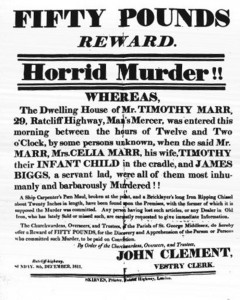
On the night of 7th December, 1811, a local draper - Timothy Marr - who lived at 29 Ratcliff Highway sent his servant Margaret out to buy some oysters, and then to go to a bakery to pay an outstanding bill. The oyster vendor she went to was closed, so she went to pay the bill and see if she could find another shop that was still open. She returned past No.29 and saw Marr through the window. The bakery was closed as well, and she could not find another oyster shop open, so returned home just after midnight - only to find the house locked up. She heard noises within - footsteps on the stairs and the crying of Marr's baby. She banged on the door but no-one came to open it. This attracted the attention of the night watchman. A neighbour was alerted and he climbed over the back wall to find the rear door lying open. Inside he found a scene of total carnage. Marr, his wife, his baby and his apprentice had all been savagely murdered.
A search of the house found nothing missing, and a large quantity of money still intact, so it was assumed that the killers had panicked and fled when Margaret returned. Footprints found at the back of the house seemed to show that there had been more than one person involved.
On December 19th, a second set of killings took place nearby. The publican of the Kings Arms on New Gravel Lane - John Williamson - was murdered in equally barbaric fashion, along with his wife and servant girl. The alarm was raised when a lodger - John Turner - lowered himself from an upper window, half dressed and screaming "Murder!". This time there was survivor - Williamson's 14 year old grand-daughter, but she had not seen the killer(s).
On December 24th, the landlord of the nearby Pear Tree Inn identified the murder weapon - a sailor's maul - as belonging to one of his lodgers. This man had been at sea at the time of the killings, but his fellow lodger, John Williams, knew the Marrs and had often drank in the Kings Arms. He became the prime suspect and was imprisoned in Coldbath Fields Prison, Clerkenwell.
Here, on 28th December, Williams hanged himself with his scarf. The suicide was taken as a sign of his guilt. No other comparable killings took place after he died.
The police were happy to presume that he was responsible for both sets of killings. The motive for the killings has never been identified. Despite there being physical evidence, and some witness statements, to support there being more than one killer no-one else was ever charged.
Williams was buried on January 1st. His body was wheeled through the area, stopping for 15 minutes outside the Kings Arms. He could not be buried in hallowed ground as he was a suicide, so he was interred beneath the crossroads outside the church of St George-in-the-East. A stake was driven through his heart. The stake was to stop the soul wandering, whilst the position at a crossroads was designed to confuse any restless spirit.
The body was dug up in the late 1800's when gas mains were being laid. The skull was kept by the landlord of the nearby Crown & Dolphin. It was displayed for many years, but its whereabouts are now unknown.


