
One of the masterpieces of the Capitoline Museums, for many years this statue was thought to represent a dying gladiator. Indeed, the room in which it is to be seen - in the Palazzo Nuovo - is still called to this day the Hall of the Gladiator, because of this erroneous misidentification.

The statue is now known to represent a Galatian warrior, nude except for a torque around his neck, with short chopped hair and a moustache. He has a wound just below the right pectoral. It is known that the Gauls often fought naked, and with lime in their hair that made it look like that represented here.
It was found in the Gardens of Caesar, once owned by Julius Caesar, near the Via Salaria. After his assassination they were bought by the historian Sallust - becoming known as the Horti Sallustius. They later reverted to the Imperial Family and were much frequented by Tiberius. The Emperor Nerva died of a fever there in 98 AD.
The statue, along with others, was discovered in 1734 when the site was bought by Ludovici Ludovisi, nephew to Pope Gregory XV, in order to build a villa. Alongside it was another statuary group which can now be seen in the Palazzo Altemps, close by Piazza Navona, which contains other Ludovisi finds. This is the group known as "The Gaul Killing Himself And His Wife".
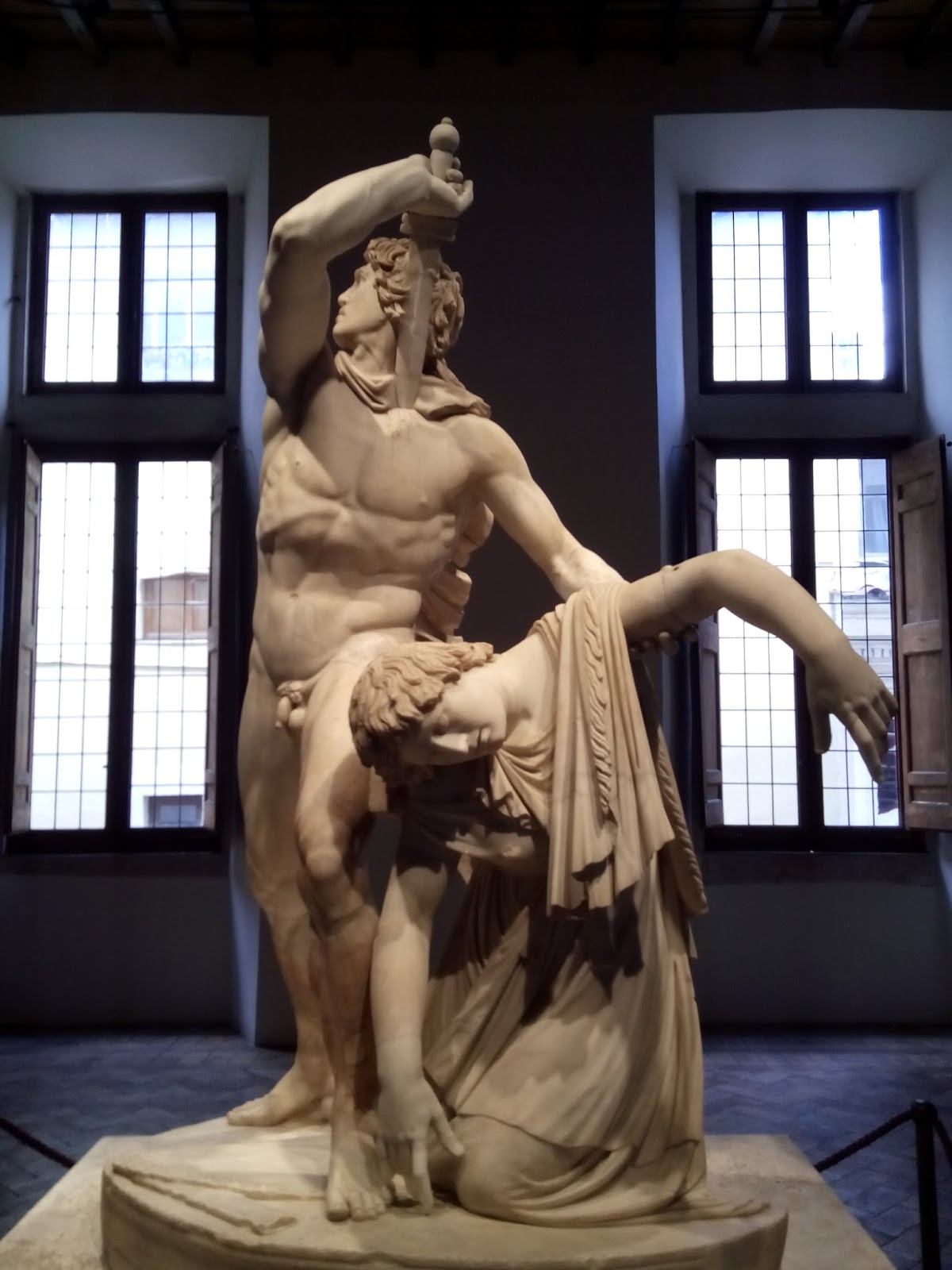
Here, another Galatian warrior has already killed his wife to prevent her falling into the hands of the Romans, and he is seen in the act of killing himself - plunging his sword into his heart through his chest. He has the same short chopped hair and a moustache, but this time wears a cloak - so may be of higher rank than the "Dying Gaul", perhaps his chieftain. Despite the fact that these two masterpieces reside in museums a mile or so apart, they were once part of a single composition.

As with many of Rome's greatest statues, the originals are thought to be Greek, and these later copies. The original for the Palazzo Altemps group was probably in bronze. It is known that the Greeks defeated Gauls who had attempted to settle in their territory around 279 BC. The date for these marble copies is not known. It might seem likely that, as they were found in gardens belonging to Julius Caesar, they dated from his time - commemorating his own victory over Vercingetorix - but equally they may have been commissioned by Sallust or a later Emperor in tribute to the deeds of the first Caesar.
Perhaps one day the two statues will be finally brought back together again, as Caesar, Sallust, or one of the later Emperors intended them to be seen.

