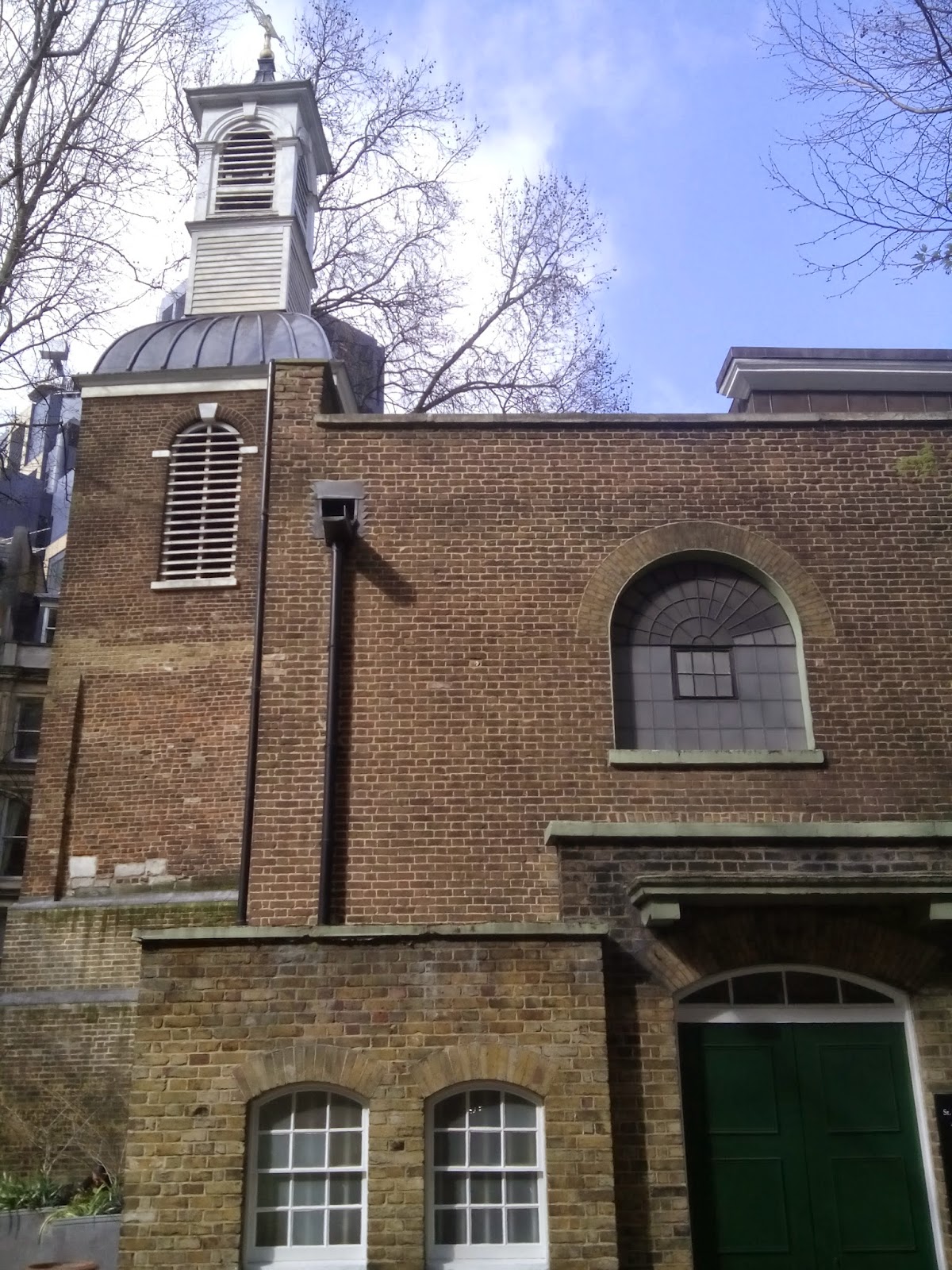
Walk northwards up Giltspur Street towards Smithfield and you will come to Pye Corner. It sits at the junction with Cock Lane. High up on the wall is the small statue a plump, golden cherub. This marks the furthest westward extent of the Great Fire of 1666. Popular feeling at the time attributed the fire to Catholics and foreigners - usually Catholic foreigners - but the fact that the conflagration began in Pudding Lane, and ended at Pye Corner, led some to believe that it was all a judgement from God for the city's sin of gluttony - hence the fat little cherub.
An inscription on the wall beneath sets out this information, but goes further to state that here at this corner once stood a tavern called the
Fortune of War. This was demolished in 1910. The landlord would show interested customers a room containing benches where dead bodies used to be laid out - each neatly labelled for the individual doctor from St. Bartholomew's Hospital (just across the road) for whom it was intended, to come and inspect it - all courtesy of the body-snatchers. Look to your right as you stand looking up at the statue and you will see a small guard post where a watchman used to keep an eye on the graveyard of the nearby church of St Sepulchre's - to deter the 'Resurrectionists' from raiding that for more cadavers.
You will see the street sign for Cock Lane in the photo at the top of the post - taken by yours truly at Easter, 2015. (No, I'm not
quite old enough to have done the cartoon that is immediately above...).
In 1762 this became the scene for one of London's most notorious hauntings - the colourfully titled Scratching Fanny of Cock Lane. The no-longer-there house at No.33 was the setting for this macabre event, which attracted the interest of Dr Samuel Johnson and the Prince of Wales as well as hundreds of intrigued on-lookers.
In a nutshell, a couple moved into the house of a Mr William Parsons - William Kent and his lover Fanny Lynes. They outwardly appeared to be a respectable couple but she was actually the sister of Kent's deceased wife. Kent and Parsons had a falling out over money. Scratching sounds soon started to be heard in the room which Fanny was sharing with Parson's 12 year-old daughter, Elizabeth, whilst Kent was away on business. These were alleged to be from the dead sister - warning Fanny that she would soon also die at Kent's hands. Kent and Fanny moved out, and she did die soon after - from smallpox. The scratching continued - but this time it was the ghost of Fanny herself accusing Kent. Parsons claimed this, and charged visitors to see the room and witness the scratching sounds for themselves. The ghost would answer questions put to it - one knock for Yes, two for No.
Everything changed when the ghost claimed that it would manifest itself at Fanny's burial place - the crypt of St John's in Clerkenwell - on a specified date. Nothing happened. Elizabeth Parsons was found to have been making the noises at Cock Lane with a wooden clapper hidden under her dress. Parsons ended up in jail for the fraud. Many years later, an artist sketching in the crypt of St John's was shown Fanny's coffin. When opened, the body was found to be in a remarkable state of preservation - something that arsenic poisoning can do. Was Kent possibly guilty of murdering his wife and his lover after all?
Two other items of note about Cock Lane:
- John Bunyan - author of The Pilgrim's Progress - died here in 1688, after catching a chill in a heavy downpour.
- The street name is nothing to do with chickens. It is as insalubrious as it sounds. This street was one of the only places in the City where prostitutes were licensed to trade.