Monday, 11 July 2016
The Dying Gaul(s)
One of the masterpieces of the Capitoline Museums, for many years this statue was thought to represent a dying gladiator. Indeed, the room in which it is to be seen - in the Palazzo Nuovo - is still called to this day the Hall of the Gladiator, because of this erroneous misidentification.
The statue is now known to represent a Galatian warrior, nude except for a torque around his neck, with short chopped hair and a moustache. He has a wound just below the right pectoral. It is known that the Gauls often fought naked, and with lime in their hair that made it look like that represented here.
It was found in the Gardens of Caesar, once owned by Julius Caesar, near the Via Salaria. After his assassination they were bought by the historian Sallust - becoming known as the Horti Sallustius. They later reverted to the Imperial Family and were much frequented by Tiberius. The Emperor Nerva died of a fever there in 98 AD.
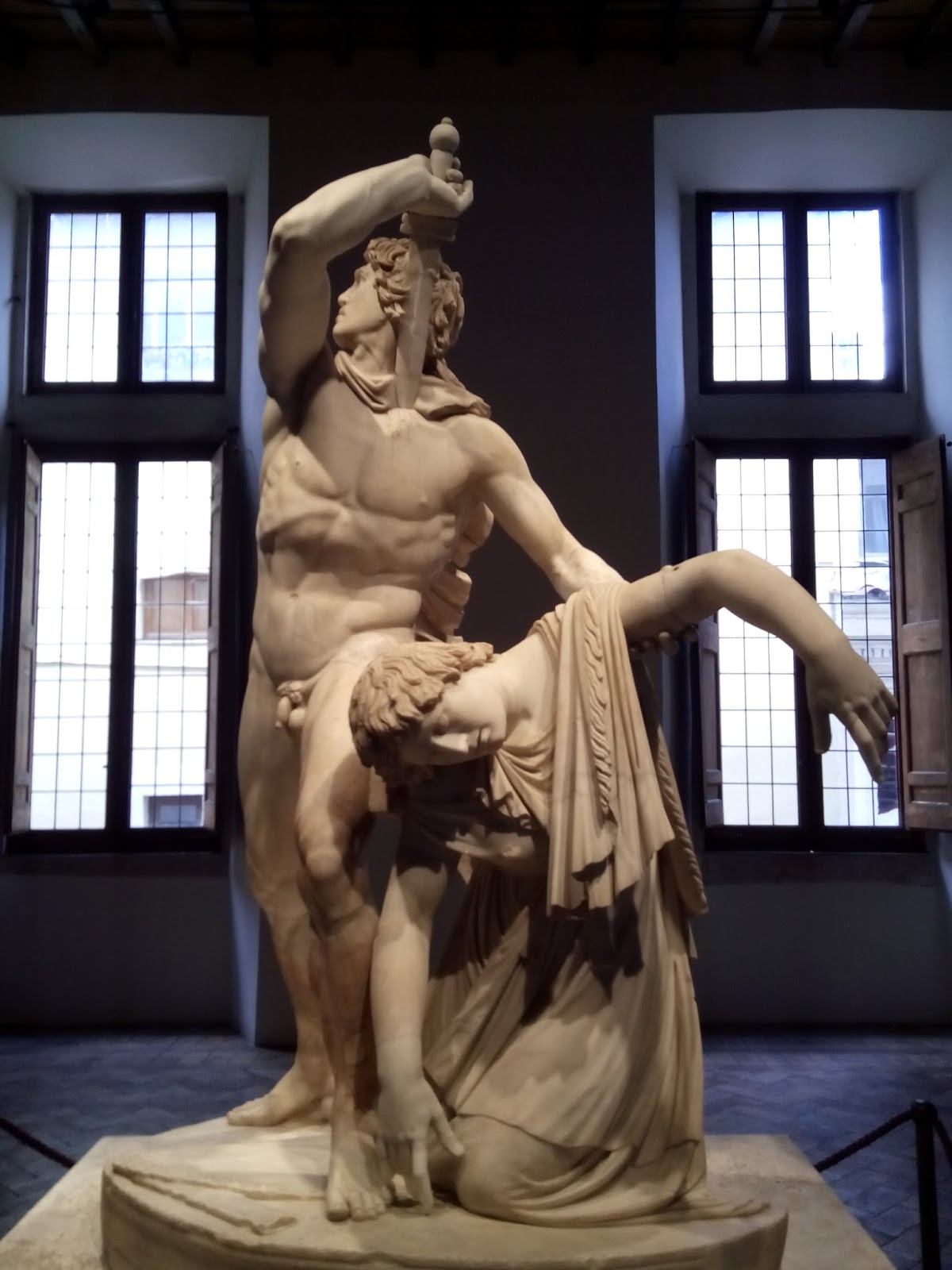
The statue, along with others, was discovered in 1734 when the site was bought by Ludovici Ludovisi, nephew to Pope Gregory XV, in order to build a villa. Alongside it was another statuary group which can now be seen in the Palazzo Altemps, close by Piazza Navona, which contains other Ludovisi finds. This is the group known as "The Gaul Killing Himself And His Wife".
Here, another Galatian warrior has already killed his wife to prevent her falling into the hands of the Romans, and he is seen in the act of killing himself - plunging his sword into his heart through his chest. He has the same short chopped hair and a moustache, but this time wears a cloak - so may be of higher rank than the "Dying Gaul", perhaps his chieftain. Despite the fact that these two masterpieces reside in museums a mile or so apart, they were once part of a single composition.
As with many of Rome's greatest statues, the originals are thought to be Greek, and these later copies. The original for the Palazzo Altemps group was probably in bronze. It is known that the Greeks defeated Gauls who had attempted to settle in their territory around 279 BC. The date for these marble copies is not known. It might seem likely that, as they were found in gardens belonging to Julius Caesar, they dated from his time - commemorating his own victory over Vercingetorix - but equally they may have been commissioned by Sallust or a later Emperor in tribute to the deeds of the first Caesar.
Perhaps one day the two statues will be finally brought back together again, as Caesar, Sallust, or one of the later Emperors intended them to be seen.
Monday, 4 July 2016
The Tomb of the Baker
Visit the Porta Maggiore, a busy road intersection and tram terminus, and you'll see the tomb of the baker Eurysaces. The tomb lies on the side facing away from the city centre, as it was tradition that people couldn't be buried within the city itself. The gate is really an overground conduit for a pair of aqueducts, named as it sits on a road that leads to S. Maria Maggiore. Take a close look at the image below and you'll see the channels that the water ran through.
These were the aqua Claudia and Anio Novus. Both were begun by Caligula, and completed under Claudius. Originally an aqueduct intersection, this only became a real gate when it became incorporated into the Aurelian Walls, sections of which can be seen on either side.
The tomb was already in existence when the gate was built. It dates to between 30 - 20 BC. The tomb survived for centuries as it was incorporated into a tower that was built onto the gate by the Emperor Honorius. It was only exposed during excavations in the 19th Century. The odd circular motifs are actually dough bins - in recognition of Eurysaces' trade. These are real bins, as there is the rusted evidence of the kneading mechanism inside each one. The columns are also created by real bread bins, standing one on top of the other three high.
An inscription reads: EST HOC MONIMENTUM MERCEI VERGILEI EURYSACIS PISTORIS, REDEMPTORIS, APPARET - This is the tomb of Marcus Vergilius Eurysaces, baker, contractor, it's obvious! Eurysaces was an ex-slave who helped provide the bread dole for the Roman people - as in bread and circuses.
The tomb is fenced off and sits on a patch of scrubby grass, so you can't get too close to it. If you could, you would see the remains of a frieze around the entablature of scenes of life in a bakery. Plaster copies can be seen in the Museum of Roman Life at the EUR district. The remains of Eurysaces' wife, Atistia, were also deposited here. She was described as an "excellent woman", and her remains could be found in this panarium (bread bin). It is believed that Eurysaces' bakery was close by where his tomb now stands.
Sunday, 3 July 2016
The Temple of Minerva Medica
In one of central Rome's less touristy sections - standing alongside the tracks leading into Termini railway station - sits what has become known as the Temple of Minerva Medica. It has been known as this since the 16th Century, but it was never a temple of any kind.
It is a 12-sided building and it used to have a concrete dome. There is evidence of underfloor heating - which led some to think it was part of a baths complex - and the walls were veneered in marble, with statues placed in niches around the interior. Unlike the Pantheon, the dome was made of thin panels of concrete attached to brick ribs. The roof survived until the 19th Century when it finally collapsed. The design was found to be too weak quite early on, as heavy buttresses were built into the structure within 20 years of its construction.
It is now widely believed to be a dining pavilion - part of a larger summer residence built by the Emperor Gallienus (253 - 268 AD). His horti (gardens) lay in this area, and he moved his entire court here each summer. Some 6th Century AD statuary was found embedded in Medieval walls built into the pavilion - suggesting the building was still in use at this time. With a busy road and tram-line on one side, and the railway tracks on the other, it is a remarkable survivor, which features in very few guidebooks.
Castrense Amphitheatre
A short distance from the church of Santa Croce Gerusalemme lies the remains of a small oval amphitheatre. Only the first and part of the second levels survive, but it originally had three tiers. The name probably derives from it being located next to the castra or barracks of the Imperial Cavalry. It is believed to date from the short reign of the Emperor Elagabalus (218 - 222 AD), designed to keep the Cavalry on his side. (The plan failed, as he and his mother were assassinated by their troops). It could seat 3500 spectators. Excavations in the 18th Century found a large number of large animal bones, so it is believed that the amphitheatre was used as a training ground for animals that would go on to feature at the Colosseum. It may also have been used for more intimate gladiatorial contests for the Emperor and his friends and family.
It owes its survival in part due to its incorporation into the Aurelian Walls in the 270's AD. This is when the open arcades were bricked up. There is a long section of well-preserved Wall in the area, running from the Castrense all the way to the Lateran.
According to Procopius the Aurelianic Walls were breached by the Goths in 537 AD at a weak point near the Praenestine Gate "at the animal enclosure" (vivarium). This may well refer to the Castrense Amphitheatre.
Monday, 13 June 2016
The Ludovisi Sarcophagus
So named from its first owner after rediscovery - Ludovico Ludovisi - and currently to be seen in the Palazzo Altemps, a short walk away from Piazza Navona.
It dates from the mid 3rd Century AD, and is believed to have been intended for Gaius Valens Hostilianus - a son of the short-lived Emperor Decius (ruled 249 - 251).
Hostilian is seen top centre, without a helmet. His outstretched arm represents both leadership and victory. The young man has an "X" on his forehead - which was a sign that he was a follower of the god Mithras, who was very popular with soldiers at this time.
The sarcophagus was found in 1621 on the Via Tiburtina, which runs NE out of Rome.
Hostilian is depicted on the sarcophagus engaged in battle against the Goths, but he was not destined to follow the fate of his father and brother.
Decius and his eldest son, Herrenius Etruscus - who co-ruled with his father - were both killed at the Battle of Abritus, in what is now Bulgaria. He was the first Roman Emperor to die in battle against a foreign enemy.
Hostilian, who became Emperor himself very briefly in 251 AD, died from the plague.
Decius' short reign was most notable for a resumption in persecutions of groups who refused to sacrifice to the Emperor. Though they weren't the only ones targeted, a large number of Christians met their deaths - including Pope Fabian in 250. Decius built a bath complex on the Aventine, the ruins of which survived until the 16th Century, and he is recorded as having repaired the Colosseum when it was struck by lightning.
This is a late example of this type of sarcophagus. Ornately carved "battle" sarcophagi were at their most popular c. 190 - 210AD.
Wednesday, 1 June 2016
Coming soon...
Have just got back from a wonderful trip to Rome - with tons of ammunition for this blog. Also, now that the better weather is on its way I'll be setting out on a lot of walks in London, so this blog has rested long enough. First new post in a couple of days...
Friday, 5 February 2016
History With The TARDIS - The Great Fire of Rome
Before I get back into the swing of things with this blog, let's take another look at how Doctor Who has portrayed key moments / figures in history. This time, it's the story commonly entitled The Romans.
On screen, the Doctor and his companions have arrived outside Rome in the year 64AD. They spend a month or so relaxing at a villa, whose owner is off campaigning in Gaul. One day, the Doctor decides to visit Rome, and young companion Vicki goes with him. Ian and Barbara stay behind - only to be captured by slave-traders. The Doctor and Vicki find the body of an elderly lyre player on their travels - one Maximus Pettulian. The Doctor decides to impersonate him, in order to find out how the old man came to be killed. Believing he has failed, the assassin tries again, but is chased off. The Doctor and Vicki arrive in Rome and meet the Imperial family - Nero and his wife Poppaea. Ian and Barbara also find themselves in the city (he having first of all spent a few days as a galley-slave).
Vicki stops Poppaea from poisoning Barbara, and almost kills Nero instead. The Doctor upsets the Emperor by playing the lyre better than him. Nero plans to have him fed to alligators in the arena, but the Doctor inadvertently sets fire to the Emperor's plans for a new Rome with his spectacle lens - inspiring Nero to deliberately torch the city so that his dream will be built. Nero plucks his lyre as the city burns. Under cover of the fire, the time-travellers make their way back to the villa, and thence off to the TARDIS.
This story was written intentionally to have a lot of humour, and so not to be taken too seriously, despite some grim things happening in it. When it comes to the real facts, it is often way off the mark.
First of all, there is the villa that the travellers are staying in. The writer seems to be thinking of a villa as a small holiday home like those round the Med you might rent today. In fact, this would have been a vast agricultural estate with an army of slaves working it all year round.
As for the absence of the owner, there wasn't any campaigning going on in Gaul at this time. He is much more likely to have been in Britain, Boudicca having rebelled just 3 - 4 years earlier.
Then we have the portrayal of the Emperor.
Nero Claudius Caesar Augustus Germanicus was 17 when he came to the throne. His mother was wife to the Emperor Claudius, and it is commonly held that she arranged the old Emperor's death in order that her son should inherit. This was 10 years before the Great Fire, so Nero should be under 30. On screen, we get Derek Francis playing him as a much older character. Very handsome as a youth, Nero did pile on the pounds thanks to his debauched lifestyle, and his double chins appear on both coins and statuary.
He certainly enjoyed the arts and performing himself - something which the Roman aristocracy disapproved of. Nero certainly planned to totally remodel Rome. He began by buying up huge sections of the Caelian Hill and extended the palace on the Palatine (from whence the word 'palace' derives) onto it. Today, under a park, lie the remains of part of his complex - the Domus Aurea or Golden House. In the flat area between the hills he had a vast ornamental lake built, and next to it a huge golden statue of himself was set up. A colossal statue in fact - which might give you a clue as to what his successors built on the site of the lake.
Two characters who appear at Nero's court are based on real figures - the cup-bearer Tigellinus, and the poisoner Locusta. The real Tigellinus was a Prefect of the Praetorian Guard. He outlived Nero - but only just. He backed the wrong successor - the short-reigned Galba - and was executed by the equally short-reigned Otho, in what is known as the Year of the Four Caesars.
Locusta, meanwhile, is supposed to have been the one employed by Nero's mother, Agrippina the Younger, to poison Claudius. She also did away with Claudius' own son and heir Britannicus. She also outlived Nero - but again only just. Galba had her executed as well.
A significant character in the TV programme is the slave-trader Sevcheria. He is a totally fictitious figure. The programme seems to be cutting the costs of an extra actor by having him suddenly become Nero's sadistic right hand man in the second half of the story. In fact, this role was closer to the real Tigellinus.
And what of the Great Fire itself? There is an old adage about Rome burning whilst Nero fiddles. Well, the programme at least has the Emperor playing a lyre, which you pluck, rather than a fiddle which you play with a bow. The ancient Romans themselves came up with a number of theories as to the cause of the fire. One was indeed that Nero was behind it, so that the Senate would allow him to build his dream Rome. He wasn't there in person, however. He was in Antium. Another story had him closer to the city, playing his lyre in the gardens of Maecenas (now a district of low rent housing just to the south of Termini station). Another theory, which Nero himself promoted, was that the fire had been started by a religious sect known as the Christians. Whatever happened to them? Christians were subjected to a dreadful persecution after the fire. Which brings us to the slave Tavius. He is shown to be a secret devotee of this new-fangled cult. He is seen to wear a crucifix. In reality, it would more likely have been the symbol of a fish he would have worn.
The theories that have Nero deliberately starting the fire all tend to come from writers who were patronised by later Emperors, so who had an agenda. At the time, Nero was only criticised for his tardiness in returning to the city to supervise the relief effort. Thousands of people were made homeless.
Nero lived only a further four years after the Great Fire. He was deposed, and chose to commit suicide rather than be captured and executed. His ashes were buried near the northern gate of the city - beside what is now the church of Santa Maria Del Popolo. This used to have a monastery attached and a tree in its grounds was supposed to be haunted by Nero's ghost - so the Pope had it cut down.
[Santa Maria Del Popolo is worth visiting for two superb Caravaggio altar pieces - The Crucifixion of St Peter, and The Conversion of St Paul. There's a side chapel designed by Raphael. Martin Luther stayed at the adjoining monastery on his trip to Rome - the one that initially triggered his desire to see the Church reformed].
One last thing - the stuff about "the arena". The Romans would probably have gone for crocodiles (from Egypt) rather than alligators. One well-respected Doctor Who guide book bemoans the fact that what we see on screen of the arena where Ian has to fight Delos is far too small to be the Colosseum... (And a Big Finish audio set during the Boudiccan Revolt has a couple of soldiers talking about visiting that well-known Roman landmark). Oh dear...
Yes, as mentioned above, at the end of Nero's life you would have got your feet wet if you visited the site of the Colosseum. Otho's successors, Vespasian and then his son Titus, drained the lake and built the famous arena. It was the first stone-built - so permanent - arena in the city. Prior to this there were only Theatres, plus temporary wood-built arenas.
Subscribe to:
Comments (Atom)