Friday, 28 August 2015

Sherlock's Final Resting Place


Back in January I attended a wedding in the New Forest, Hampshire. The day after the festivities, a few hardy souls decided to clear their heads by taking part in a car treasure hunt around the area. One of the locations we visited was the tiny village of Minstead - and I was surprised to come across the grave of Sir Arthur Conan Doyle. Surprised, as I knew he was born in Edinburgh (in 1859), lived for many years in South Norwood (not far from where I currently live) and died in Crowborough, East Sussex (in 1930).
It transpires that this was not his first burial place. He was reburied alongside his wife in Minstead later.


The church is called All Saints. It dates, in part, from the 13th Century. One of the pews, reserved for the local gentry, even has its own fireplace, unusually.
There had been some controversy regarding Doyle's burial, as he maintained that he was not a Christian. He regarded himself as a Spiritualist.

Wednesday, 19 August 2015

Gordon Square and the Bloomsbury Group


Inspired by the BBC's recent drama "Life In Squares", about the Bloomsbury Group, I thought I would have a wander round the area that gave them their name. (Ignore the date stamp on the pics - I haven't a clue how to change it. I usually use my phone but it has recently had a falling out with the laptop and refuses to import pictures :-(

The Group was formed at Cambridge University as the 19th Century gave way to the 20th. Unlike other artistic groups of the same period, they did not have any political agenda, or issue any kind of manifesto. It was simply a group of writers / artists who shared a particular philosophy towards their work and the way they lived their lives.
The core members were the Stephen sisters (painter Vanessa and writer Virginia), Clive Bell, Duncan Grant, Lytton Strachey, E M Foster, Roger Fry, Gwen Darwin (granddaughter of Charles) and the economist John Maynard Keynes. Vanessa is better known by her married name (she wed Clive Bell), and Virginia by her married name - Woolf.
As well as the body of work they produced, the Group is well known for its interpersonal relationships. Duncan Grant, for instance, had sexual relationships with his cousin Lytton Strachey, and Keynes, and Vanessa Bell.

Victoria House, Bloomsbury Square
The area is dominated by University College London (UCL) these days, as well as the British Museum and the School of Oriental and African Studies (SOAS).
Bloomsbury Square, part of the Bedford Estate, which gave the area its name, is fairly non-descript these days. The southern side is a busy main road. It is dominated by the huge Beaux Arts Victoria House on the east side. This was considered for the seat of the Mayor and the London Assembly for a time, until it was decided to create a new building on the south side of the Thames opposite the Tower of London.
(It is said that the reason the nearby Senate House of UCL was spared bombing during WW2 because Hitler had his eye on it for his HQ were an invasion to be successful).

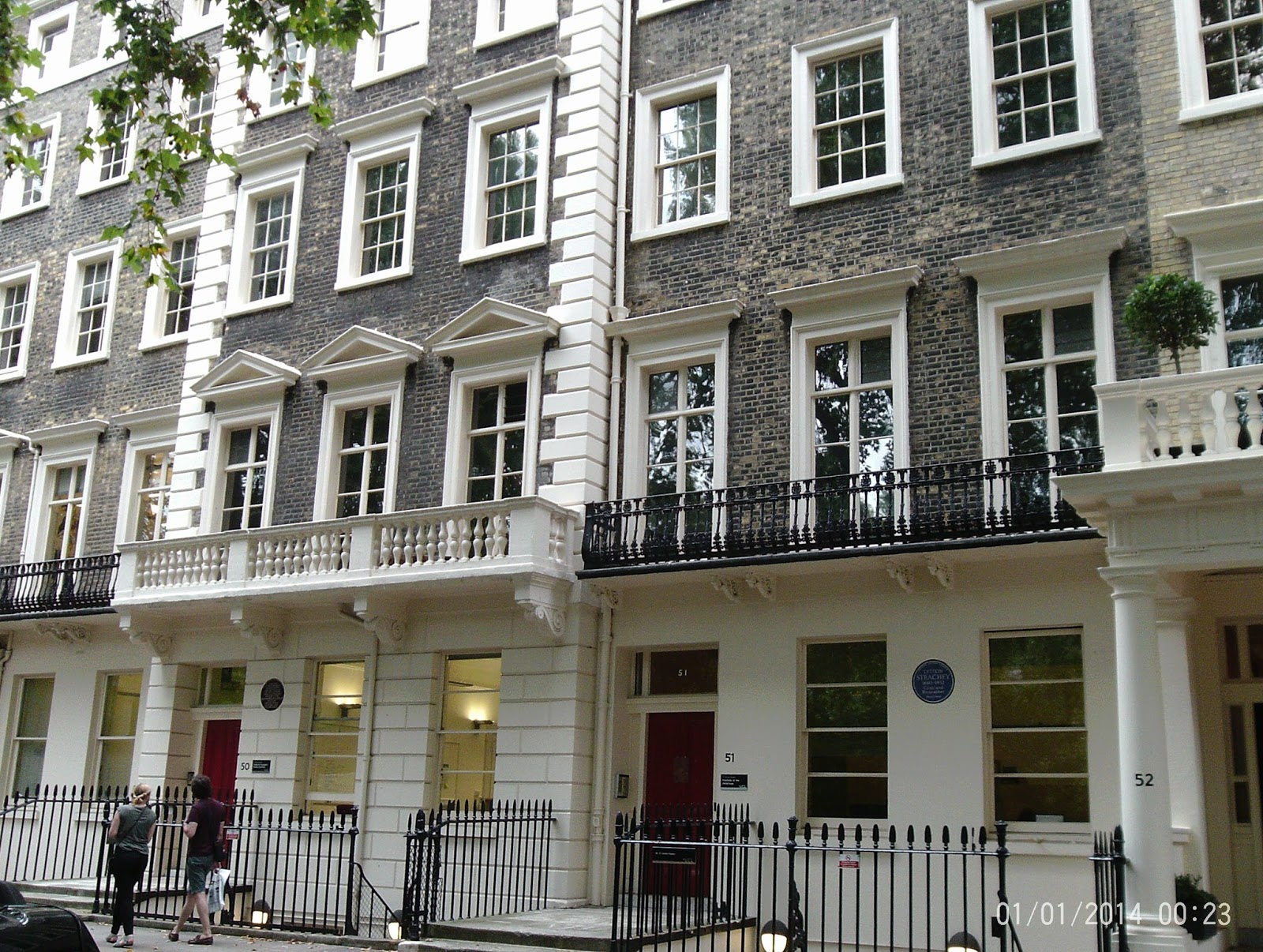
46 - 50 Gordon Square
If there is one address which is synonymous with the Group it is probably Gordon Square.
No.37 was home to Vanessa Bell and Duncan Grant in 1925.
No.46 was an earlier home for Vanessa (from 1904). John Maynard Keynes moved into it a few years later.
No.50 was Clive Bell's address between 1922 - 39, and where the Group regularly met.
No.51 was home to Lytton Strachey from 1919.


There are a number of other addresses in the vicinity which were closely associated with the Group, but which no longer exist - thanks mainly to WW2 bombing:
38 Brunswick Square was home to 5 members of the Group between 1911 - 12.
34 Mecklenburg Square was where Virginia Woolf volunteered for a Suffrage group just before the First World War. It later became HQ for the Women's Trade Union League.
She and her husband, Leonard, moved into No.37 in August 1939.
Before that, she lived for 15 years at 57 Tavistock Square. It is now the Tavistock Hotel.


At the south west corner of Gordon Square is Byng Place. Here stands the University Church of Christ the King. Built between 1851 - 54 for the Catholic Apostolic Sect, it was supposed to have the tallest spire in London, but this never materialised. The sect died out and in 1963 it was leased to the Church of England for use as the UCL chaplaincy. The church has a collection of ceremonial vestments - including one that is reserved exclusively for Christ, should he ever make his Second Coming.


Whilst the output of the Bloomsbury Group is globally admired, the members were disliked by those outside their circle.
Rupert Brooke, the poet, described the "rotten atmosphere in the Stracheys' treacherous and wicked circle". D H Lawrence hated "this horror of little swarming selves". Wyndham Lewis referred to them as "elitist, corrupt and talentless".
A recent BBC series on Bohemianism tackled the Bloomsbury Group and found against them - as they were all from privileged backgrounds and so could afford to live the way they did. Spolied snobs, basically. Real Bohemians don't just play at being so. The same programme was pretty negative about the whole current Hipster style. Unimaginative clones, basically.
I do admire the Group's work. And Keynes should not be blamed for that New Town just north of London that bears his name.

Saturday, 15 August 2015

Update

Have been rather busy with the Doctor Who blog, plus other stuff. Expect an update in the next couple of days. Just watched the BBC's Life In Squares, and have been inspired for a trip into Bloomsbury...

Friday, 31 July 2015

Lunch with Blake, Bunyan & Defoe


This afternoon I found myself sitting on a bench eating lunch next to the poet John Bunyan. That's the writer of Pilgrim's Progress. Who died in 1688.
I was in Bunhill Fields - a cemetery on the northern edge of the City. It lies in the Finsbury district, between the Northern Line stations of Moorgate and Old Street.


The name is a corruption of "Bone Hill". In 1549 a massive number of bones were moved here from the churchyard of St Paul's Cathedral. Later, from 1657, it became the leading Noncomformist Cemetery. Following the Civil Wars of the 1640's, a number of Protestant sects established themselves. Only Anglicanism was recognised by the state, and followers of these other movements found they could not be buried in Church of England graveyards.
It remained London's principle dissenters' cemetery until 1854, when the laws relating to religion were relaxed. (The Burial Act of 1852 had also come into force). There are an estimated 230,000 inhumations in the Fields, and some 2000 graves are still marked today.


Daniel Defoe (of Robinson Crusoe fame) wrote an account of the Great Plague of 1665 - A Journal of the Plague Year - and he states that Bunhill Fields was used as a plague pit. He claims some stricken individuals, mad with fever, threw themselves into the pits and expired. Defoe himself was later buried here. He was on the run from creditors when he died, so was buried under the name Mr Dubow. The obelisk marking his grave was stolen, and turned up down in Southampton. After a time in Stoke Newington Library, it was returned to Bunhill Fields where it can be seen today. Just next to it is the tombstone of the visionary painter and poet William Blake, along with his wife.


As you can see from the image above, the stone does not mark the actual location of his body.
Just across from the City Road entrance to the Fields is the Chapel and House of the Methodist leader John Wesley. His mother, Susanna, is buried in the Fields. Also here is the poet Robert Southey.
Quakers had there own separate section of the cemetery. George Fox, one of the founders of the Quaker Movement, is buried there.
Some more views of the Fields:


Above is the tomb of Dame Mary Page (d. 1728). She was the wife of shipping magnate Sir Gregory Page. On the opposite side to this inscription is another which states that over 67 months some 240 gallons of water were extracted ("tapp'd") from her. This obviously refers to some medical complaint from which she suffered - and presumably died from - involving retention of water in the body.


Today it is a popular place for City workers to enjoy an alfresco lunch in the finer weather.
Part of the grounds are used by the Honourable Artillery Company, which is based next to the Fields. The HAC is the oldest military company in London - Finsbury Fields used to be used for archery practice from the Tudor period. These grounds saw some of England's first ever cricket matches.

I have had a good long look and cannot find any good ghost stories attached to this cemetery. Quakers and Methodists obviously rest easier in their graves...

Saturday, 25 July 2015

St Anne's Limehouse


Like St George-in-the-East, a church by the architect Nicholas Hawksmoor - assistant to Sir Christopher Wren. It was another of the churches built as part of the "50 New Churches Act" during the reign of Queen Anne. The parish of Limehouse grew out of the old parish of St Dunstan's, Stepney, in 1709. The building was completed in 1727, and consecrated in 1730.
The clock is the highest church clock in London - as it had to be seen by shipping on the Thames. The gold ball at the top of the tower was used as a navigation marker for shipping. The church has had a long association with the navy. When the last HMS Ark Royal was decommissioned, the Ensign flag was presented to St Anne's.
The church was gutted by a fire in 1850, but managed to survive the Blitz. Beneath the Portland Stone flooring is the original Queen Anne brick surface.


The church features prominently in the works of author Peter Ackroyd - in Hawksmoor and Dan Leno and the Limehouse Golem.
Nicholas Hawksmoor has gained a reputation for having been more interested in paganism than Christianity. This is partly due to a pyramid that sits in the graveyard of St Anne's. This has "The Wisdom of Solomon" carved upon it.


Many believe this mysterious structure demonstrates Hawksmoor's interest in ancient masonic rites and sacred geometry. However, the pyramid was simply supposed to cap one of the corners of the church but Hawksmoor changed his mind and set it up in the yard. This fact hasn't stopped the conspiracy theorists. The pyramid has its own separate Grade II listing.
The war memorial, with a statue of Christ in bronze and a plaque featuring a WWI battlefield also has its own Grade II listing.

Monday, 13 July 2015

History With The TARDIS - The Visitation


A Doctor Who story with a conclusion set in London, 1666? It can only mean the Great Fire.
The bulk of this story sees the Fifth Doctor, with companions Tegan, Nyssa and Adric, encountering the survivors from a crashed alien escape ship. These reptilian Terileptils do not want to be rescued, however, as they are escaped convicts. They would rather take over the Earth as their new home - getting rid of the human inhabitants using a genetically engineered variant of the plague. This takes place in 17th Century Middlesex - round about where Heathrow Airport will be built in a few centuries time.
The Doctor must track the Terileptils to their secondary base which has been set up in London. The plague-infected rats are being stored in a bakery here awaiting release. In a struggle, a burning brazier is knocked over and one of the alien handguns falls into the flames. The aliens use a highly flammable gas to compensate for Earth's atmosphere - and when the gun explodes it starts a major conflagration. The Doctor works out what this means for history - saying this fire should be allowed to run its course. When the TARDIS dematerialises, we see the name of the street where the bakery is situated - Pudding Lane...


One of those occasions when the Doctor is responsible for a major historical event - one that he is unable to alter.
The real Great Fire did indeed begin in a bakery - that of a Thomas Farriner (or Farynor) - in Pudding Lane. It started in the chimney of the shop just after midnight on September 2nd. Apart from the big civic buildings, this was a city of wood, with houses crammed together on narrow streets. The fire quickly spread to adjoining properties.
There wasn't any fire brigade in these times, just the watchmen who patrolled the streets plus local militia known as the Trained Bands. Each parish church had to hold equipment for fire-fighting - ladders and long fire-hooks. The latter were to help pull down building that were already ablaze or at risk of fire. This would create fire-breaks, that a fire would not be able to cross.
When the Lord Mayor of London - Sir Thomas Bloodworth - was informed of the fire, he is supposed to have exclaimed: "Pish! A woman could piss it out." Diarist Samuel Pepys was woken by a maid at about 3am. He took a look, considered it not much of a threat, and then went back to bed. By morning, the full extent of that threat was becoming apparent.
The Mayor's failure to take the fire seriously and create fire-breaks in the first few hours had meant that it had spread over a wide area of the City. The previous month had been extremely dry, and there was now a strong easterly wind. Once the fire reached the river side, it met with a number of highly flammable materials being stored in the numerous wharves and warehouses. Pepys went to the Tower to observe the fire from on high, then set off by boat to Whitehall Palace to report to King Charles (II) and his brother the Duke of York. Later, Pepys settled himself at an inn on Bankside, in Southwark, to watch the progress of the fire from there. When his own home was threatened, he buried his most prized possessions in the garden - including his cheese.
People whose homes had burned were forced to move further and further away - some having to transport their belongings four or five times in a day, as the fire continued to spread wider and wider. The various city gates became congested with people fleeing the city. Finsbury Fields would eventually become a tented town for those made homeless.
The fire did not abate until September 5th.
It had destroyed more than 13,000 houses, 87 churches, 44 Company Halls, and three City Gates, as well as major buildings such as the Royal Exchange and the Guildhall. Its most famous casualty would be the medieval St Paul's Cathedral. The lead from its roof melted and ran down the streets.
The official death toll was only 6, but this is widely believed to be a gross underestimate. There would have been many people living in the affected areas who were not properly registered with the authorities. The heat from the fire would have totally cremated bodies - leaving little sign.


One thing the Doctor might have found ironic is that aliens were blamed for starting the fire. These aliens were foreigners - especially Catholic ones. One Frenchman did actually admit to starting the fire deliberately, and he was hung for it. However, it was then discovered that he did not arrive in the City until after the fire had been raging for two days. He was at sea when it began.
Some lynchings and other attacks were reported on foreign tradesmen, though many thought these merely used the fire as an excuse to get rid of business competitors.
Plans to totally redesign the layout of the city came to nothing, due to the complexity of the land ownership. This means that the narrow winding street named Pudding Lane can still be visited today.
"Pudding" does not refer to delicacies cooked up by Thomas Farriner's bakery. "Puddings" were piles of stinking offal from slaughtered animals which dropped to the ground as they were transported down this street to be dumped in the Thames.


There are two monuments to the Fire to be seen in London today. One is the golden cherub statue at Pye Corner, Smithfield (subject of an earlier post), and of course The Monument.
Until 1830, the plaque at the base of the Monument continued to explicitly blame Catholics for causing the fire. The height of the Monument is the same as the distance from its base to where Farriner's bakery stood. At the top is a golden urn with flames. Sir Christopher Wren wanted to place a statue of King Charles on top, but he refused, saying "It wasn't me who started the fire...".

Wednesday, 8 July 2015

St George-in-the-East and the Ratcliff Highway Murders


St George-in-the-East is a Hawksmoor designed church, built as part of the Fifty New Churches Act during the reign of Queen Anne. It was constructed between 1714 - 1729. It lies south of Whitechapel, and north of Wapping, at a junction between Cannon Street Road and the Highway.
In 1850 it was the scene of a dispute between High and Low Church Anglicans. (High Church services have more ceremony - something Low Church followers feel is too close to Catholic rites). When the Bishop of London appointed a Low Church man to the parish, the locals demonstrated their disapproval by keeping their hats on, smoking their pipes and encouraging their dogs to bark in the church.


The church interior was destroyed when a bomb hit it in May 1941. Only the shell of Hawksmoor's building survives. Within is a smaller, modern church, built in 1964. There is a Montessori School in the crypt.
The gardens - St George's Park - to the east are built on the church's graveyard, so the walls have old gravestones along them. A number of tombs and monuments are still scattered about the lawns.


In one corner of the park there is also the burned out shell of what was once a small natural history museum.


The entrance to the park from the north - Cable Street - takes you past the famous mural depicting the 1936 "Battle of Cable Street", when the local Jewish population and a number of socialist groups joined forces and prevented a march by Oswald Mosley's Fascist Blackshirts from marching through the area.


In the grounds of the church are buried victims of East London's most notorious murders, after the Ripper killings. The street which now runs east towards Limehouse called the Highway was once known as Ratcliff Highway (Ratcliff being a corruption of red cliff - a topographical feature of the area).


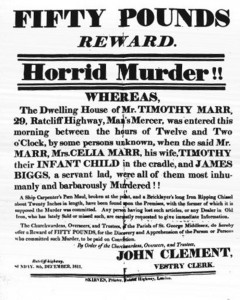
On the night of 7th December, 1811, a local draper - Timothy Marr - who lived at 29 Ratcliff Highway sent his servant Margaret out to buy some oysters, and then to go to a bakery to pay an outstanding bill. The oyster vendor she went to was closed, so she went to pay the bill and see if she could find another shop that was still open. She returned past No.29 and saw Marr through the window. The bakery was closed as well, and she could not find another oyster shop open, so returned home just after midnight - only to find the house locked up. She heard noises within - footsteps on the stairs and the crying of Marr's baby. She banged on the door but no-one came to open it. This attracted the attention of the night watchman. A neighbour was alerted and he climbed over the back wall to find the rear door lying open. Inside he found a scene of total carnage. Marr, his wife, his baby and his apprentice had all been savagely murdered.
A search of the house found nothing missing, and a large quantity of money still intact, so it was assumed that the killers had panicked and fled when Margaret returned. Footprints found at the back of the house seemed to show that there had been more than one person involved.


On December 19th, a second set of killings took place nearby. The publican of the Kings Arms on New Gravel Lane - John Williamson - was murdered in equally barbaric fashion, along with his wife and servant girl. The alarm was raised when a lodger - John Turner - lowered himself from an upper window, half dressed and screaming "Murder!". This time there was survivor - Williamson's 14 year old grand-daughter, but she had not seen the killer(s).
On December 24th, the landlord of the nearby Pear Tree Inn identified the murder weapon - a sailor's maul - as belonging to one of his lodgers. This man had been at sea at the time of the killings, but his fellow lodger, John Williams, knew the Marrs and had often drank in the Kings Arms. He became the prime suspect and was imprisoned in Coldbath Fields Prison, Clerkenwell.
Here, on 28th December, Williams hanged himself with his scarf. The suicide was taken as a sign of his guilt. No other comparable killings took place after he died.


The police were happy to presume that he was responsible for both sets of killings. The motive for the killings has never been identified. Despite there being physical evidence, and some witness statements, to support there being more than one killer no-one else was ever charged.
Williams was buried on January 1st. His body was wheeled through the area, stopping for 15 minutes outside the Kings Arms. He could not be buried in hallowed ground as he was a suicide, so he was interred beneath the crossroads outside the church of St George-in-the-East. A stake was driven through his heart. The stake was to stop the soul wandering, whilst the position at a crossroads was designed to confuse any restless spirit.
The body was dug up in the late 1800's when gas mains were being laid. The skull was kept by the landlord of the nearby Crown & Dolphin. It was displayed for many years, but its whereabouts are now unknown.